Busan Subway Guide: Lines, Transfers, Beaches, Markets, and Airport Access
Lines, T-money, Busan subway passes, Gimhae Airport transfers, key stations, and first-trip mistakes
Navigate Busan subway by destination clusters: Haeundae, Gwangalli, Seomyeon, Nampo, Busan Station, and Gimhae Airport.
Busan Subway Guide for First-Time Visitors
The Busan subway is one of the easiest ways to move around Busan on a first trip.
Think in Clusters, Not Single Stations
Busan is spread along coastlines and hills. Subway travel becomes easier when you group destinations: Haeundae and Blue Line Park, Gwangalli and Suyeong, Seomyeon as the center, Nampo and Jagalchi, Busan Station, and Gimhae Airport.
Busan's main attractions are spread across a wide coastal city. You may stay near Haeundae, arrive at Busan Station, eat around Seomyeon, visit Jagalchi Market, shop in Nampo-dong, or spend an evening near Gwangalli Beach. The subway connects many of these areas in a way that is usually easier to understand than bus routes.
Busan's subway system is smaller and simpler than Seoul's, but first-time visitors can still get confused by direction, transfers, T-money, metro passes, airport access, and last-train times.
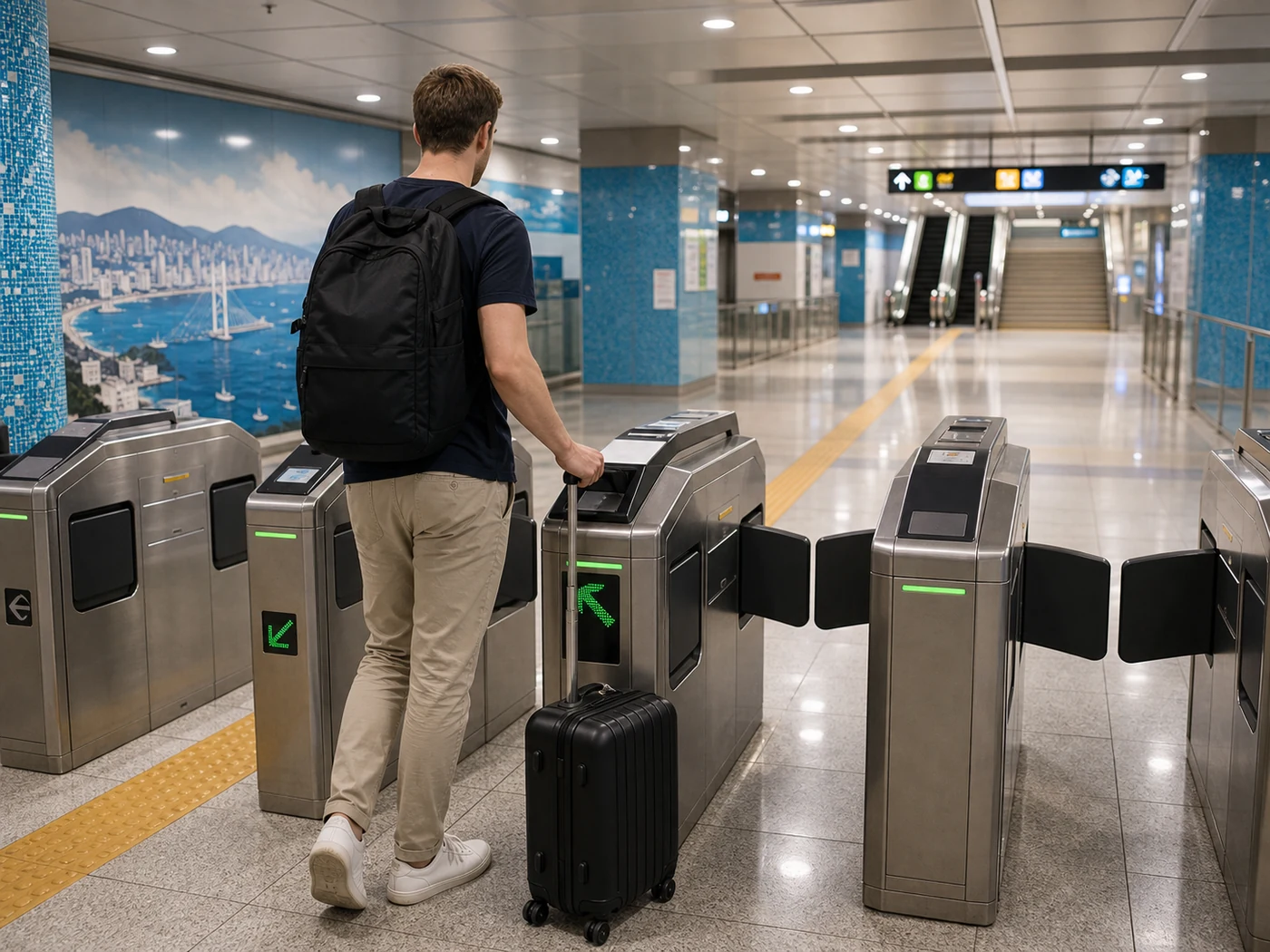
Why the Busan Subway Is Useful for Travelers
The subway is useful because many major visitor areas are close to a station.
It works especially well if your trip includes:
- Busan Station
- Seomyeon
- Nampo-dong
- Jagalchi Market
- Haeundae
- Gwangalli
- Centum City
- Gwangan Bridge viewpoints
- BEXCO or the Shinsegae Centum City area
Compared with taxis, the subway gives you more predictable travel times during traffic-heavy periods. Compared with buses, it is usually easier for first-time visitors to follow because lines, station names, and transfers are more structured.
That said, the subway does not reach every attraction directly. Places such as Gamcheon Culture Village, Taejongdae, Songdo, and some coastal viewpoints may require a bus, taxi, or extra walk after the nearest station.
Basic Busan Subway Lines to Know
For most first-time visitors, you do not need to memorize the whole network. Start with the lines you are most likely to use.
Line 1 is useful for Busan Station, Nampo, Jagalchi, and several north-south city routes.
Line 2 is useful for Seomyeon, Gwangan, Centum City, and Haeundae.
Line 3 and Line 4 are useful for certain local transfers, but many short-term visitors use them less often unless their accommodation or destination is along those lines.
The Busan-Gimhae Light Rail Transit is important if you are arriving at Gimhae International Airport and want to connect to the metro network.
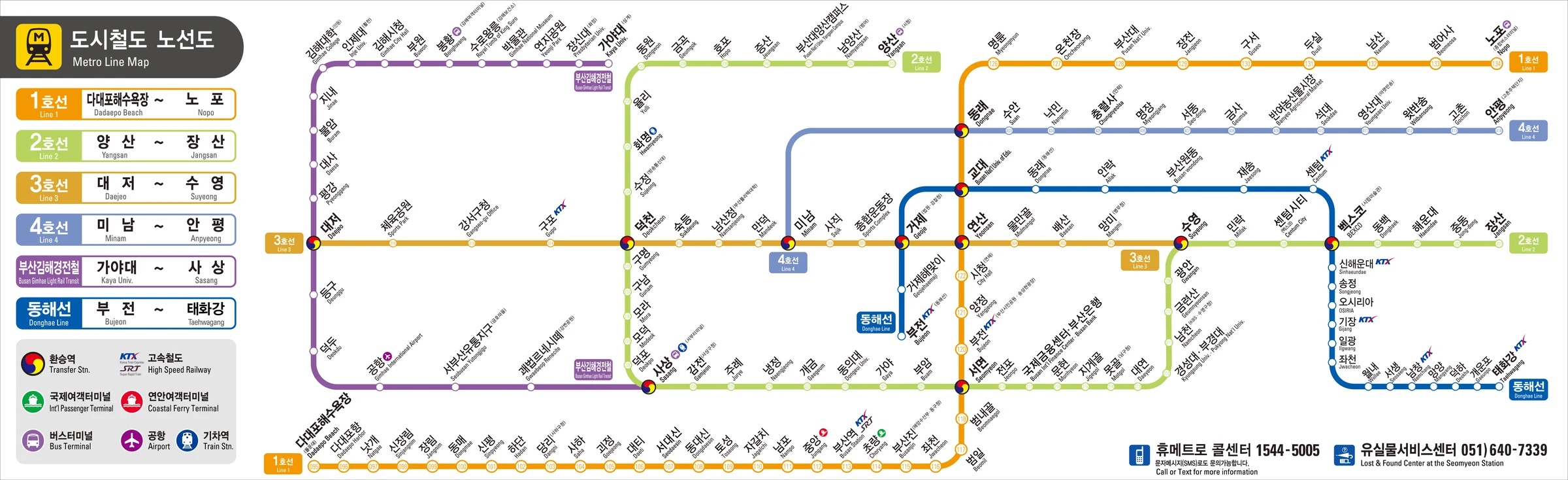
When planning a ride, check two things:
- The line number or color
- The direction, usually shown by the terminal station
Do not board only because the line number is correct. You also need the correct direction.
Key Stations for Busan Travelers
These are some of the stations visitors often use.
Busan Station
Busan Station is the main KTX and train arrival point for many travelers coming from Seoul or other cities. It connects to Subway Line 1.
Seomyeon Station
Seomyeon is one of Busan's main commercial areas and a major subway transfer point. It is useful for shopping, food, nightlife, and changing between Line 1 and Line 2.
Nampo Station
Nampo Station is useful for Nampo-dong, BIFF Square, Gukje Market, and the waterfront area around Yongdusan Park.
Jagalchi Station
Jagalchi Station is useful for Jagalchi Market and nearby market streets. It can also be a starting point for routes toward Songdo or Gamcheon Culture Village by bus or taxi.
Haeundae Station
Haeundae Station is the main subway station for Haeundae Beach, hotels, restaurants, and nightlife around Haeundae.
Gwangan Station and Nearby Stations
For Gwangalli Beach, check your exact destination. Gwangan Station is commonly used, but depending on where you are going, Geumnyeonsan Station or Suyeong Station may also make sense.
Can You Use T-money on the Busan Subway?
Yes, transportation cards such as T-money are commonly used for public transportation in Busan.
Visit Busan notes that Hanaro Card is Busan's official transit pass, but also says that regional cards such as T-money and Cashbee can be used for transfer discounts. Visit Korea also describes Korean transportation cards such as Tmoney and EZL as chargeable prepaid cards used for public transportation.
For most short-term visitors, using the same T-money card you used in Seoul is the simplest option. Tap the card at the gate when entering and again when leaving.
Keep enough balance on the card. If the balance is too low, the gate may not open or you may need to adjust your fare.
Buying Tickets vs Using a Transportation Card
If you do not have a transportation card, you can buy a ticket or mobile QR ticket option through station machines, depending on the current station setup.
However, if you will use subway and buses several times, a transportation card is usually easier because:
- You do not need to buy a ticket for every ride
- You can use it on subway and many buses
- It can help with eligible transfer discounts
- It is more flexible than a subway-only pass
For most visitors, the easiest setup is:
- Use T-money or another compatible transportation card for normal rides
- Keep some Korean won or another payment method ready for top-ups
- Use Naver Map or KakaoMap to check routes and station exits
Should You Buy a Busan Subway Pass?
Busan also offers subway passes for people who plan to use the urban railway many times within a short period.
According to the Busan Transportation Corporation fare guide checked on June 28, 2026, mobile season-ticket options include:
- 1-Day Pass: KRW 6,000 for adults
- 3-Day Pass: KRW 13,000 for adults
- 1-Month Pass: KRW 45,000 for adults, with a set number of one-way trips
The 1-day and 3-day options can be useful if you plan to ride the Busan subway repeatedly on the same day or over several days.
However, this is not always the best choice for tourists. A Busan subway pass may be limited to the urban railway system and may not cover buses, taxis, or the Busan-Gimhae Light Rail Transit. If your itinerary includes beaches, markets, hills, villages, or places that require buses, T-money may be more flexible.
Consider a Busan subway pass if:
- You are staying near a subway station
- You plan many subway rides in one day
- Your route is mostly within the metro network
- You do not need many buses or taxis
Use T-money instead if:
- You will combine subway, buses, and taxis
- You are visiting places not directly near stations
- You prefer a simple card for multiple transport types
- You are unsure how many subway rides you will take
Always check the current pass price, sales method, app requirement, refund rule, and covered lines before buying.
Getting from Gimhae Airport to Busan by Rail
Gimhae International Airport is connected to the Busan-Gimhae Light Rail Transit.
The airport's official English guidance lists two common subway transfer routes:
- Use the light rail and transfer to Subway Line 2 at Sasang Station
- Use the light rail and transfer to Subway Line 3 at Daejeo Station
Which transfer is better depends on your final destination.
For example:
- Haeundae or Gwangan areas often involve Line 2
- Some northern or transfer routes may use Line 3
- Busan Station and Nampo areas may require additional transfers
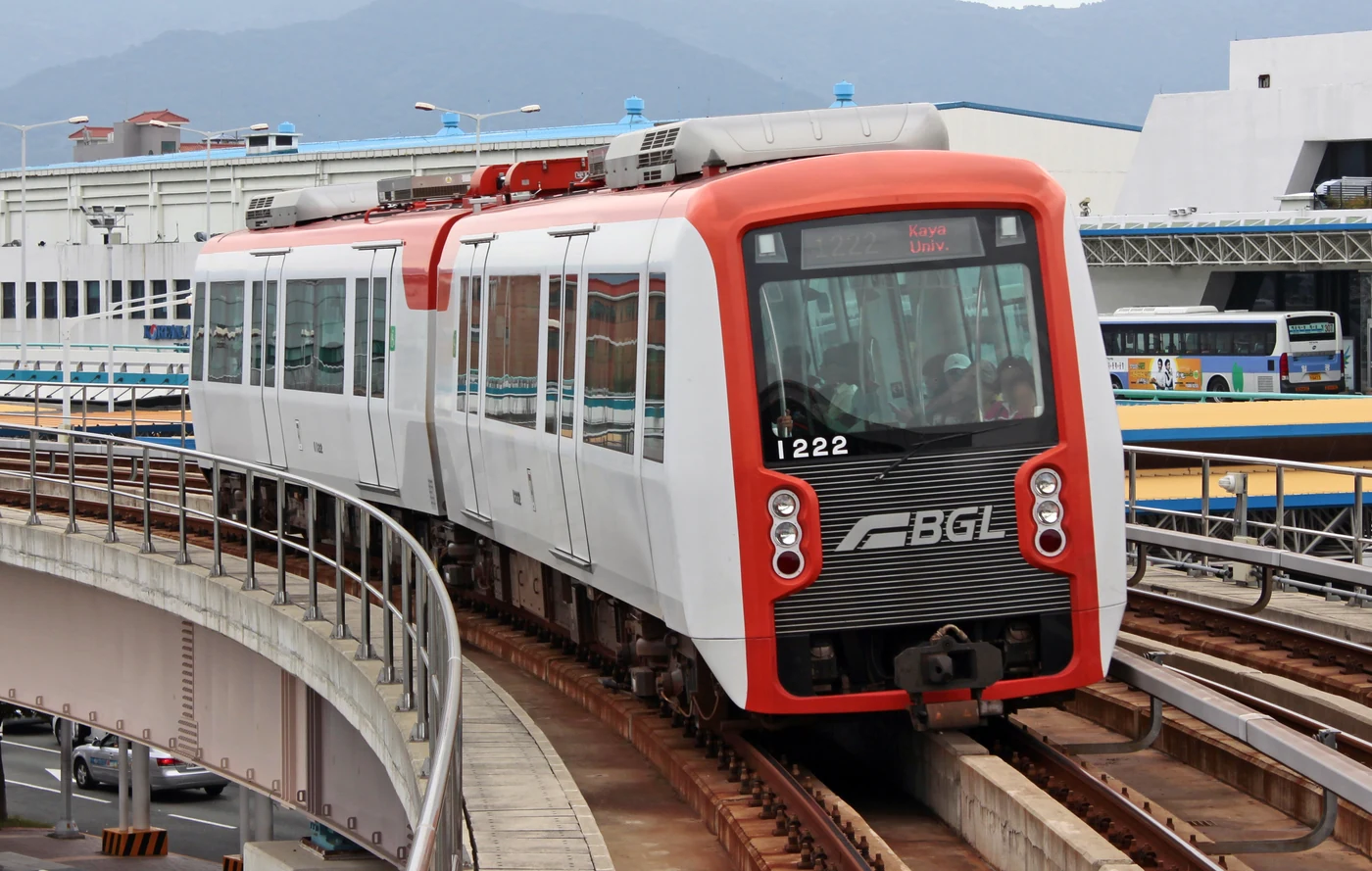
If you have heavy luggage, compare the rail route with an airport limousine bus, taxi, or private transfer. Rail can be efficient, but transfers and station exits may be tiring after a long flight.
Getting to Major Tourist Areas by Subway
Haeundae
Use Line 2 to Haeundae Station. The beach area is walkable from the station, but check your hotel location because Haeundae is spread out.
Gwangalli
Gwangalli Beach is usually reached from stations on Line 2, with some walking required. Check whether Gwangan, Geumnyeonsan, or Suyeong is better for your exact destination.
Seomyeon
Seomyeon is a major transfer and food area. It is convenient for connecting Line 1 and Line 2.
Nampo-dong
Use Line 1 to Nampo Station for Nampo-dong, BIFF Square, Gukje Market, and nearby shopping streets.
Jagalchi Market
Use Line 1 to Jagalchi Station. This is one of the easiest major attractions to reach by subway.
Busan Station
Use Line 1 to Busan Station for KTX and train connections.
How Transfers Work
If you need to change lines, follow the transfer signs inside the station.
In most normal subway transfers, you stay inside the paid area and do not exit through the gates. Large stations such as Seomyeon can require some walking, so allow extra time if you are carrying luggage or trying to catch a train.
Use your map app to check:
- Transfer station
- Line direction after transfer
- Recommended exit number
- Estimated walking time
If you leave the paid area by mistake, your fare may be affected. Follow "Transfer" signs rather than "Exit" signs unless your route requires leaving the station.
Last Trains and Operating Hours
Busan subway trains operate from early morning until late at night, but the last train depends on the station, line, direction, day, and final destination.
Do not assume that "around midnight" means every route will still take you all the way to your destination. Late trains may stop earlier than the final terminal.
Before a late dinner, beach visit, or nightlife plan, check the last useful train in Naver Map, KakaoMap, or the official operator information. If the last train is inconvenient, plan for a taxi or a shorter route.
Tips If You Have Luggage
Subways are manageable with luggage, but they are not always the easiest option.
Keep these points in mind:
- Avoid rush hours when possible
- Check elevator locations if you have large suitcases
- Do not assume every station exit has an elevator
- Allow extra time at transfer stations
- Consider taxis for short final stretches from the station to your hotel
If you are arriving from Gimhae Airport with several bags, compare the rail route with a direct bus, taxi, or airport transfer before deciding.
Combining Subway, Bus, and Taxi
The subway is a strong base for Busan travel, but buses and taxis fill the gaps.
You may need a bus or taxi for:
- Gamcheon Culture Village
- Taejongdae
- Songdo Beach and Songdo Cable Car
- Some hillside neighborhoods
- Some coastal viewpoints
- Hotels far from the nearest station
For these places, use the subway for the long, simple part of the route, then finish by bus or taxi.
This is where T-money is often more flexible than a subway-only pass. A transportation card can work across more transport situations, while a subway pass may only be helpful if you are staying mostly on metro lines.
Common First-Time Mistakes
Avoid these common Busan subway mistakes:
- Boarding without checking the direction
- Assuming Gwangalli and Haeundae are the same area
- Forgetting to check T-money balance
- Choosing the wrong station for Gwangalli Beach
- Underestimating walking time inside Seomyeon Station
- Planning a late-night return without checking the last train
- Assuming every tourist spot is subway-only
- Buying a subway pass before checking whether buses are needed
- Not checking the Gimhae Airport transfer route before arrival
Example Routes
Gimhae Airport to Haeundae
Use the Busan-Gimhae Light Rail Transit, then transfer to the subway network. The exact route depends on current schedules and your hotel location.
Busan Station to Nampo-dong
Use Line 1 toward the Nampo or Jagalchi area. This is one of the simpler subway rides for visitors.
Seomyeon to Gwangalli
Use Line 2 toward the beach side of the city, then walk from the best station for your exact destination.
Haeundae to Gwangalli
Use Line 2 for the main part of the trip. Check whether Gwangan, Geumnyeonsan, or Suyeong works best.
Busan Station to Haeundae
This usually requires using Line 1 and transferring to Line 2. Allow enough time, especially with luggage.
Before You Travel Checklist
- Prepare T-money or another compatible transportation card
- Check whether a Busan subway pass makes sense
- Save your hotel station
- Install Naver Map or KakaoMap
- Check your Gimhae Airport route if flying in
- Save your first subway destination
- Check whether your itinerary needs buses or taxis
After You Arrive Checklist
- Check your transportation-card balance
- Confirm the correct line and direction
- Check the transfer station if needed
- Check your exit number
- Look up the last train before late-night plans
- Keep a taxi backup for places not near stations
The Busan subway is not difficult once you understand the main lines and stations. Use it as the backbone of your trip, then add buses or taxis where Busan's hills, beaches, and coastal attractions require a little extra movement.
Information verified June 28, 2026. Busan subway fares, pass rules, mobile-ticket requirements, transfer policies, and last-train times can change. Check official operator information before travel.